Curated Routine

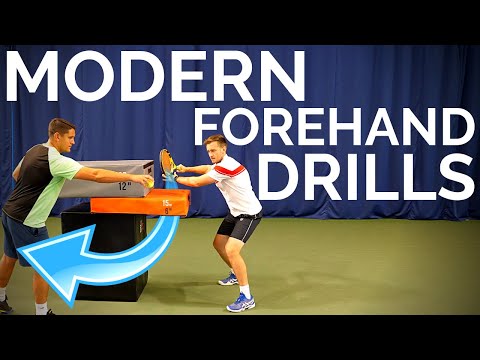
Modern Tennis Forehand - 5 Drills You Must Do

Tennis
Training ~8 minStart follow-along — free, no signup
Created from “Modern Tennis Forehand - 5 Drills You Must Do” by Top Tennis Training - Pro Tennis LessonsWatch original

Modern Tennis Forehand - 5 Drills You Must Do is a curated workout routine with 5 ordered actions and 5 short form clips. Start with Partner Hand-Rolled Ball 45-Degree Topspin Brush Drill and Foam Block Obstacle Forehand Lift & Net Clearance Drill. Review the available targets, sets, coaching cues and rest for each action. Estimated training time is about 8 min; rest is listed per action.

Training ~8 minOriginal video 10:125 actionsSingle training session
Start this session

Follow in order

Action Sequence

Browse all actions
0:00 / 2:06
1

Partner Hand-Rolled Ball 45-Degree Topspin Brush Drill

Sets: 1Reps: 10 repsRest: 1 minClip: 2 min 6 sec

Develop modern forehand topspin generation by recreating a low-to-high 45-degree racket brushing path using a hand-rolled ball placed directly under the strings.

Before you start

  • Use a tennis racket and tennis balls.
  • Partner kneels or stands nearby ready to place/feed a hand-rolled ball under the racket strings.
  • Adopt a modern semi-western or western grip to generate heavy topspin.

Movement sequence

  1. Place a tennis ball underneath the stationary racket strings.
  2. Initiate a low-to-high motion using leg drive and active wrist/hand rotation.
  3. Brush up steeply along a 45-degree angle, rolling the ball smoothly up the strings over the target.

Key points

  • Racket path follows a distinct 45-degree angle going from low to high.
  • Active wrist rotation and leg push are integrated into the brush motion.
  • The ball stays in contact and rolls cleanly up the strings along the intended trajectory.

Common mistakes

Swinging flat through the ball instead of creating a steep low-to-high brush path. Failing to use wrist rotation and legs to assist the upward ball roll.

Practice notes

Recreates the exact slow-motion biomechanics observed in elite professional topspin forehands.

0:00 / 1:24
2

Foam Block Obstacle Forehand Lift & Net Clearance Drill

Sets: 1Reps: 10 repsRest: 1 minClip: 1 min 24 sec

Master the correct 45-degree upward ball trajectory and net clearance required for heavy topspin by hitting balls over foam block obstacles.

Before you start

  • Position foam blocks or obstacles in front of the player.
  • Partner stands ready to drop-feed balls in front of the player.
  • Racket held with semi-western/western grip.

Movement sequence

  1. Coach drop-feeds a ball in front of the player.
  2. Player utilizes leg drive and a low-to-high racket brush path to lift the ball upward.
  3. Clear the foam block obstacles with sufficient vertical trajectory and depth.

Key points

  • Ball travels on a high 45-degree lift trajectory to clear the blocks.
  • Legs and low-to-high brushing action are actively engaged.
  • Shots avoid dropping short or hitting into the net.

Common mistakes

Hitting the ball too straight or flat, causing it to crash into the net or land short. Not lifting the ball with enough vertical trajectory.

Practice notes

Bridges racket path mechanics (Drill 1) with real ball flight trajectory.

0:00 / 2:01
3

Rear Block Static Backswing Check & Release Drill

Sets: 1Reps: 10 repsRest: 1 minClip: 2 min 1 sec

Adopt the explosive ATP-style forehand backswing by placing a block behind the body to prevent the racket from wrapping too far back.

Before you start

  • Place a tall foam block or obstacle directly behind the player's back.
  • Player assumes a static setup position with their arm/racket touching or positioned next to the block.
  • Partner stands ready to feed balls via drop-feed or hand-feed.

Movement sequence

  1. Position the arm and racket next to the rear block, avoiding a deep WTA-style backswing behind the body line.
  2. Coach feeds the ball to the player.
  3. Player releases from the static blocked position, leading with the butt cap, and executes the forehand shot.

Key points

  • Racket head does not break the line of the body or go behind the back.
  • Elbow and racket stay away from the body during setup.
  • Explosive release generated through a proper wrist lag.

Common mistakes

Taking the racket too far back behind the body (WTA-style linear swing). Allowing the arm or racket to collide with the rear block during the swing.

Practice notes

Emulates ATP pro mechanics for generating explosive power and angles without a giant linear backswing.

0:00 / 2:05
4

High-to-Low Loop Under Rear Block Dynamic Forehand Drill

Sets: 1Reps: 10 repsRest: 1 minClip: 2 min 5 sec

Execute a continuous high-to-low swing loop and dynamic wrist lag without breaking the body line, navigating past a rear obstacle.

Before you start

  • Position a rear block obstacle behind the player.
  • Partner holds balls for live or drop feeds.
  • Player ready for full dynamic swings.

Movement sequence

  1. Perform a continuous high-to-low racket loop while maintaining a wrist lag.
  2. Lead forward with the butt cap so the racket swings smoothly underneath/around the block.
  3. Make clean contact with the incoming ball and finish over the shoulder.

Key points

  • Continuous, smooth swing loop from high to low.
  • Racket never breaks past the rear body line/block.
  • Legs drive the stroke while wrist lag creates explosive acceleration.

Common mistakes

Bringing the racket from underneath the blocks incorrectly due to poor butt cap leading. Interrupting the continuous swing flow.

Practice notes

Encourages topspin, proper racket path, and depth on the opposing side.

0:00 / 1:39
5

Torso Rotation & Lateral Spacing Block Drill

Sets: 1Reps: 10 repsRest: 1 minClip: 1 min 39 sec

Develop full-body coiling, uncoiling trunk rotation, and proper lateral ball spacing by using a rear block to prevent arm collapse.

Before you start

  • Position a rear block obstacle behind the player.
  • Partner feeds balls slightly away from the player to test lateral spacing.
  • Player prepared for full rotating shots.

Movement sequence

  1. Maintain proper lateral distance from the incoming ball to prevent getting jammed.
  2. Execute a full body turn (coil and uncoil motion) generating power from the trunk and legs.
  3. Swing forward with a smooth, straight path while keeping the contact point away from the body, blocked from crossing inward.

Key points

  • Sufficient space maintained between the body and the ball (no jamming).
  • Power generated from trunk rotation and legs rather than just the arm.
  • Rear block prevents the arm from crossing inward across the body.

Common mistakes

Standing too close to the ball, resulting in getting jammed up. Failing to turn and rotate the body/trunk to generate power.

Practice notes

Boxes, foam rollers, or any safe obstacles can substitute if professional blocks are unavailable.

Video demonstrations are referenced from public platforms for instructional context. TrainFlow is independent and not affiliated with or endorsed by the original content creators.