Curated Routine

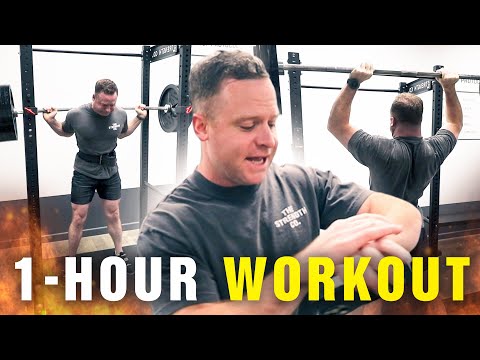
Workouts Shouldn't Take Long | 1 Hour Starting Strength Workout

Strength Training
Training ~6 minStart follow-along — free, no signup
Created from “Workouts Shouldn't Take Long | 1 Hour Starting Strength Workout” by The Strength Co.Watch original

Workouts Shouldn't Take Long is a curated workout routine with 3 ordered actions and 3 short form clips. Start with Low Bar Back Squat Session & Warm-Up Progression / Rest Interval Management and Standing Overhead Press Training / Shoulder Press Protocol. Review the available targets, sets, coaching cues and rest for each action. Estimated training time is about 6 min; rest is listed per action.

Training ~6 minOriginal video 7:523 actionsSingle training session
Start this session

Follow in order

Action Sequence

Browse all actions
0:00 / 4:37
1

Low Bar Back Squat Session & Warm-Up Progression / Rest Interval Management

Sets: 3Reps: 10 repsRest: 4 minClip: 4 min 37 sec

Demonstration and execution of the low bar back squat following a time-efficient warm-up protocol and structured rest intervals.

Before you start

  • Keep a gym timer (rack timer) to maintain honest rest intervals
  • Perform warm-up sets efficiently starting with the squat first
  • Put on lifting belt securely before work sets

Movement sequence

  1. Perform warm-up progression up to working sets (e.g., empty bar, intermediate weights up to 365 lbs and 405 lbs work sets)
  2. Unrack the bar and position it on the spine of the scapula (low bar position)
  3. Take a deep breath and execute the Valsalva maneuver for intra-abdominal pressure
  4. Initiate descent with hip drive, pushing knees out and keeping eyes focused on the correct gaze point
  5. Perform 3 sets of 5 repetitions at working weight (405 lbs working set followed by back-off sets at 365 lbs)

Key points

  • Bar placement securely across the spine of the scapula
  • Knees pushed out and tracking properly over toes
  • Strict adherence to rest intervals (using a rack timer set for 4 minutes between heavy sets)

Common mistakes

Leaving the lifting belt on continuously between sets instead of popping it off to allow proper breathing and oxygen restoration Inconsistent rest intervals or losing track of time without a visible timer

Practice notes

Squatting first optimizes warm-up efficiency since subsequent upper body lifts require fewer warm-up sets Pop the belt off between sets to move air, restore ATP, and recover effectively

0:00 / 1:05
2

Standing Overhead Press Training / Shoulder Press Protocol

Sets: 3Reps: 5 repsRest: 1 minClip: 1 min 5 sec

Execution of the standing overhead shoulder press following the squat, utilizing an abbreviated warm-up and structured rest periods.

Before you start

  • Leverage prior squat warm-ups to minimize additional warm-up requirements for the press
  • Prepare specific warm-up weight increments (empty bar x 5, 95 lbs x 3, 135 lbs x 2, 185 lbs x 1)

Movement sequence

  1. Unrack the barbell for working sets (demonstrated with 200 lbs)
  2. Set grip width and maintain a tight core via the Valsalva maneuver
  3. Press the barbell overhead in a vertical bar path
  4. Complete 3 sets of 5 repetitions with 4-minute rest intervals between sets

Key points

  • Focus intensely on the rep at hand (especially on rep number 4 where fatigue sets in)
  • Maintain a vertical bar path with full lockout overhead

Common mistakes

Getting mentally overwhelmed by heavy working weights (needing focus and music motivation like the Beastie Boys on speed dial) Rushing or skipping proper belt management during rest periods

Practice notes

Because the press follows squats in a time-constrained workout, warm-ups can be streamlined (e.g., 5 with bar, 3 at 95, 2 at 135, 1 at 185 before work sets) Keep rest periods tightly managed at 4 minutes to fit the entire session into one hour

0:00 / 0:56
3

Bodyweight Pull-Up & Chin-Up Volume Training / Assistance Work

Sets: 4Reps: 8 repsRest: 1 minClip: 56 sec

Performing assistance volume training with pull-ups and chin-ups at the end of the workout to accumulate volume.

Before you start

  • Unload the barbell from previous heavy lifts
  • Set a timer for short rest intervals (1 minute to 90 seconds, working up to 2 minutes)

Movement sequence

  1. Approach the pull-up/chin-up bar
  2. Select grip variation (e.g., wide grip pull-ups for shorter range of motion and greater back emphasis, or standard chin-ups)
  3. Perform multiple sets targeting high volume (e.g., aiming for 4 to 5 sets of 8 reps, totaling around 40 to 45 reps)
  4. Rest 60 to 90 seconds between sets

Key points

  • Maintain consistent rep execution without overthinking the assistance work
  • Control breathing and manage fatigue under cardiovascular strain

Common mistakes

Overthinking assistance movements when they are placed at the end of a primary strength workout Taking excessively long rest intervals that break the 1-hour workout time cap

Practice notes

Assistance work like chin-ups and pull-ups build endurance capacity (beneficial for military fitness tests like the Marine PFT) Keep rest short (1-2 minutes) to efficiently wrap up the full workout within the 1-hour timeframe

Video demonstrations are referenced from public platforms for instructional context. TrainFlow is independent and not affiliated with or endorsed by the original content creators.