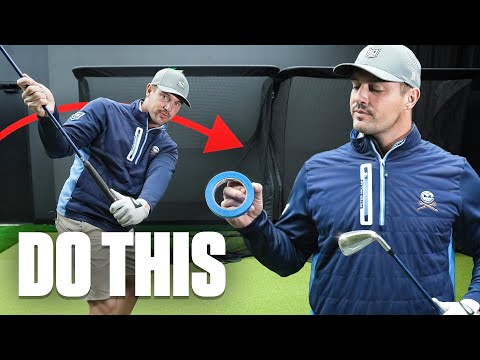
Curated Routine

How To Drastically Improve Your Handicap Indoors (No Simulator)

Golf
Start follow-along — free, no signup
Created from “How To Drastically Improve Your Handicap Indoors (No Simulator)” by Bryson DeChambeauWatch original

How To Drastically Improve Your Handicap Indoors (No Simulator) is a curated workout routine with 3 ordered actions and 3 short form clips. Start with Masking Tape Low-Point Control Line Drill and Two-Tee Center-Face Gate Drill. Review the available targets, sets, coaching cues and rest for each action. Targets and rest are listed per action.

Original video 11:073 actionsSingle training session
Start this session

Follow in order

Action Sequence

Browse all actions
0:00 / 4:35
1

Masking Tape Low-Point Control Line Drill

Sets: 3Hits: 10 hitsAttempts: 12 attRest: 1 minClip: 4 min 35 sec

A low-point strike quality drill using masking tape applied directly to the indoor turf to simulate hitting out of a bunker or turf and ensure ball-then-divot contact.

Before you start

  • Get a piece of masking tape (painters tape, Sharpie, chalk line, or spray paint can also be used)
  • Set your 60-degree wedge (or iron) down
  • Tape down a straight line on the turf to serve as a starting line

Movement sequence

  1. Position the golf ball right in front of the line on the target side
  2. Address the ball making sure your angle of attack and radius go down properly
  3. Swing and feel like you fractionally just clip the front edge of the tape, ensuring your divot occurs in front of the line

Key points

  • Instant visual feedback on the astro turf: the tape should barely peek up behind a lot of turf coming up, indicating you struck the ball after the line

Common mistakes

Chunking the shot: hitting behind the line, which immediately pulls up and breaks the tape Thin shots: feeling bad with low trajectory and poor contact

Practice notes

Consistency benchmarks: 5 times in a row for a 10 handicap level, 10 to 12 times in a row for a scratch golfer, and 20 times for a tour player without making a mistake Golf is not about what you can do once, but how many times you can do it consecutively

0:00 / 3:45
2

Two-Tee Center-Face Gate Drill

Sets: 3Hits: 10 hitsAttempts: 12 attRest: 1 minClip: 3 min 45 sec

An impact centeredness drill using two tees placed in the astro turf on either side of the ball to train center-face contact and avoid toe or heel strikes.

Before you start

  • Ensure you feel confident with striking the ball consistently from the first drill
  • Put two tees in the astro turf to create a gate wider than your club face

Movement sequence

  1. Set the ball and lean the shaft over so that when you swing through, the club face passes cleanly through the middle without striking either tee
  2. Execute a full swing (e.g., using a wedge or 8-iron)
  3. Focus on center contact every time without touching a tee

Key points

  • Clean pass through the two tees without displacing them, showing precise face-center contact

Common mistakes

Hitting on the toe: striking the heel tee with the club while the ball hits the toe Shanking: having the toe strike the right-side tee and hitting the shaft with the golf ball

Practice notes

Relates to Tiger's putter gate drill adapted for full golf shots Metrics for consistency: 5 times in a row for a 10 handicap, 10 times for a scratch golfer, 15 to 20 times for elite players

0:00 / 2:21
3

Vertical Net Tape Start-Line Precision Drill

Sets: 3Hits: 10 hitsAttempts: 12 attRest: 1 minClip: 2 min 21 sec

A face-to-path alignment and ball control drill using a vertical masking tape line attached to the indoor hitting net to track initial start-line precision.

Before you start

  • Take masking tape and put it down on the starting line on the turf where your ball is positioned
  • Draw or apply a straight vertical masking tape line all the way up the hitting net in line with the ball position

Movement sequence

  1. Set the ball up in line with the turf tape and the net tape target line
  2. Hit shots and observe where the ball starts relative to the vertical tape line on the net
  3. Practice shaping shots by controlling face angle and path (e.g., opening the face and swinging along your feet line for a big cut)

Key points

  • Immediate visual feedback on whether the ball starts left, right, or directly down the center of the vertical net tape

Common mistakes

Starting the ball unintentionally to the left or right of the net tape due to improper face-to-path alignment

Practice notes

Combines all three pillars of indoor mastery: body control (angle of attack / divot), club control (center-face contact), and ball control (face angle and start line)

Video demonstrations are referenced from public platforms for instructional context. TrainFlow is independent and not affiliated with or endorsed by the original content creators.