Curated Routine

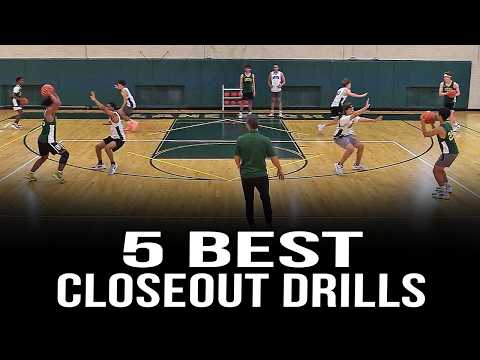
5 Best Basketball Closeout Drills V1 | Top Drills For Elite Individual Defense

BasketballCardio & Conditioning
Training ~9 minStart follow-along — free, no signup
Created from “5 Best Basketball Closeout Drills V1 | Top Drills For Elite Individual Defense” by BreakthroughBBallWatch original

5 Best Basketball Closeout Drills V1 is a curated workout routine with 5 ordered actions and 5 short form clips. Start with Touch and Chop Closeout Drill and 1-on-1 Low, Level, and Lock Drill. Review the available targets, sets, coaching cues and rest for each action. Estimated training time is about 9 min; rest is listed per action.

Training ~9 minOriginal video 15:045 actionsSingle training session
Start this session

Follow in order

Action Sequence

Browse all actions
0:00 / 0:17
1

Touch and Chop Closeout Drill

Sets: 3Reps: 5 repsRest: 1 minClip: 17 sec

Players chop their feet, sprint out on the coach's call to touch the baseline/line, then close out under control on a perimeter ball handler with high active hands and inside-shoulder angle.

Key points

  • Chop feet quickly and explode out into the closeout
  • Decelerate with short, choppy steps and squeaky shoes without lunging
  • Position head on the inside shoulder to close the door and force toward outer thirds

Common mistakes

Lunging out of control, jumping in the air, or leaving an open gate to the middle of the court.

0:00 / 0:20
2

1-on-1 Low, Level, and Lock Drill

Sets: 3Reps: 5 repsRest: 1 minClip: 20 sec

Live 1-on-1 containment drill emphasizing the 'Three Ls' (Low, Level, and Lock) to cut off straight-line dribble penetration and absorb the offensive drive with a horizontal first step.

Key points

  • Get low with defensive shoulders below the offensive player's shoulders
  • Level off the driver by beating them horizontally on their first dribble step
  • Lock on and slide or turn and run to wall up without fouling

Common mistakes

Standing too upright, lunging on the first step, or failing to turn and run when beaten.

0:00 / 0:20
3

Star Closeout and Push-Step Conditioning Drill

Sets: 3Reps: 5 repsRest: 1 minClip: 20 sec

Individual defender sprints from the paint to close out at perimeter spots (corner, wing, top of the key), contests the shot, executes a box-out step, and push-steps back to the paint before sprinting to the next spot.

Key points

  • Sprint at top speed halfway, then break down with choppy steps and hands high
  • Stay low and disciplined on the shot contest and box-out contact
  • Push-step defensively into the paint before bursting into the next closeout

Common mistakes

Failing to drop hips on the closeout, dropping hands during the box-out, or relaxing on recovery push-steps.

0:00 / 0:20
4

Three-Line Positional Closeouts Drill

Sets: 3Reps: 5 repsRest: 1 minClip: 20 sec

Three simultaneous lines execute closeouts tailored to floor thirds: defenders pass from gap or straight-up positions, sprint out yelling 'ball', take away the 3-pointer and right hand, and call 'dead' when the ball is picked up.

Key points

  • Pass from designated gap or straight-up position and sprint on the air time of the ball
  • Shout 'ball' loudly on closeout and 'dead' when the offensive player picks up their dribble
  • Take away the step-in three and right-hand drive, forcing the ball handler to their left

Common mistakes

Closing out silently without communication or allowing uncontested right-handed drives.

0:00 / 0:18
5

Defensive Footwork Pattern Breakdown (Slide, Help & Closeout)

Sets: 3Reps: 5 repsRest: 1 minClip: 18 sec

Players execute a choreographed defensive footwork pattern across the floor: defensive slide-slide, crossover sprint into help position, recover, and skip-pass closeout with high hands.

Key points

  • Maintain low stance throughout slides without clicking heels together
  • Execute clean crossover recovery steps into help-side positioning
  • Break down smoothly into a balanced closeout on the simulated skip pass

Common mistakes

Crossing feet during the primary defensive slide or losing balance during the transition to help position.

Video demonstrations are referenced from public platforms for instructional context. TrainFlow is independent and not affiliated with or endorsed by the original content creators.