Curated Routine

BEST Putting Drills that will LOWER Your Score || 3 Drills

Golf
Training ~1 minStart follow-along — free, no signup
Created from “BEST Putting Drills that will LOWER Your Score || 3 Drills” by Porzak GolfWatch original

BEST Putting Drills that will LOWER Your Score is a curated workout routine with 3 ordered actions and 3 short form clips. Start with Straight Uphill Putt Alignment Rod & Around-the-World Break Read Drill and Todd Sones 3-to-1 Stroke Ratio & Follow-Through Stop Drill / Impact Acceleration. Review the available targets, sets, coaching cues and rest for each action. Estimated training time is about 1 min; rest is listed per action.

Training ~1 minOriginal video 10:403 actionsSingle training session
Start this session

Follow in order

Action Sequence

Browse all actions
0:00 / 2:35
1

Straight Uphill Putt Alignment Rod & Around-the-World Break Read Drill

Sets: 1Reps: 10 repsRest: 0 secClip: 2 min 35 sec

A drill focused on identifying the straight uphill putt on a green using eyes, feet, and senses (recognizing that greens are typically built back to front with the front as a low point and back as a higher point) and placing an alignment rod down the line.

Before you start

  • Grab an alignment rod.
  • Observe the green's general slope (most greens are built back to front, meaning the front is low and the back is high).

Movement sequence

  1. Walk around the hole using eyes, feet, and senses to feel and locate low points and high points.
  2. Determine the straight uphill putt line.
  3. Place the alignment rod down along the straight uphill putting line.
  4. Hit putts from various quadrants around the hole ('around the world') to observe how each break relates to the straight uphill reference line.

Key points

  • The ball does not move excessively sideways when putted down the straight uphill alignment rod line.
  • Correct identification of uphill/downhill and right-to-left/left-to-right breaks relative to the uphill reference rod.

Common mistakes

Guessing green reads without finding the core straight uphill baseline first. Ignoring overall green topography (back-to-front slope principles).

Practice notes

Better players are always aware of where the straight uphill putt is on the golf course. Taking time to find this baseline builds extreme confidence in green reading.

0:00 / 2:02
2

Todd Sones 3-to-1 Stroke Ratio & Follow-Through Stop Drill / Impact Acceleration

Sets: 1Reps: 10 repsRest: 0 secClip: 2 min 2 sec

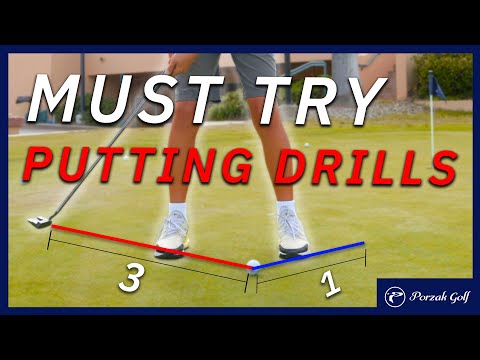
A lag putting technique and drill inspired by renowned putting coach Todd Sones. It addresses the number one amateur mistake on long putts—taking too short of a backswing and hitting/forcing the ball—by enforcing a 3-to-1 backswing-to-follow-through ratio, letting the weight and energy of the putter do the work, and keeping the putter face square.

Before you start

  • Position yourself for a long putt (25 to 30 feet away from the hole).
  • Visualize the target distance and focus purely on speed control rather than forcing the ball into the cup.

Movement sequence

  1. Take a significantly larger backswing to generate the necessary energy naturally.
  2. Allow the weight of the putter to swing in and fall into the golf ball ('hit it soft').
  3. Maintain a 3-to-1 tempo ratio where the backswing is three times the length of the follow-through.
  4. Practice stopping the putter head past impact (or keeping the follow-through shorter than the backswing, e.g., using a coach's shaft as a swing restriction barrier).

Key points

  • Backswing length is visibly three times longer than the follow-through.
  • The putter face stays square and stable through impact instead of twisting from forced muscle application.
  • The ball comes out with a consistent exit speed without firing out too fast.

Common mistakes

Taking a backswing that is too short on long putts. Feeling the need to 'hit' or force the ball with muscular effort to make it travel farther, causing inconsistent speed and face rotation.

Practice notes

Stats show 12-handicappers three-putt 15-footers more often than they make them; focusing on lag speed lowers scores. Every lag putt should feel soft, driven by the pendulum weight of the putter rather than a jerky strike.

0:00 / 1:07
3

Random Three-Hole Lag Speed Ladder Game / Distance Control within a Putter Length

Sets: 1Reps: 6 repsRest: 0 secClip: 1 min 7 sec

A random practice game designed to test speed control and course management under pressure. The golfer selects three different holes at random on the practice green and attempts to lag putts from distance so they finish within a putter length (or club length) of the hole in a row.

Before you start

  • Choose a target number in a row (e.g., 3 successful putts).
  • Pick different holes at random around the putting green to confuse yourself and vary green speeds (moving between slow and fast putts).

Movement sequence

  1. Select a random hole (such as an uphill 30-footer).
  2. Execute the lag putt focusing solely on speed control and letting the putter do the work.
  3. Verify that the ball finishes within a club length (putter length) of the hole.
  4. Move to a completely different hole and repeat the process sequentially until the target number of successful putts in a row is achieved.

Key points

  • Putting speed is dialed in such that even missed putts finish inside a 6-foot wide window (3 feet past or around the hole).
  • Successfully completing the sequence across random holes without breaking concentration.

Common mistakes

Obsessing over making long putts instead of prioritizing lag distance control. Practicing from the exact same spot repeatedly instead of randomizing distances and breaks.

Practice notes

College golf coaches frequently emphasize that young players need better speed control. Visualizing the hole as 6 feet wide (3 feet on each side) provides immense mental comfort for converting lag putts into tap-in pars.

Video demonstrations are referenced from public platforms for instructional context. TrainFlow is independent and not affiliated with or endorsed by the original content creators.