Workout Template:
Action-Driven Exercise Routine Sheet
Tired of messy notes and clunky spreadsheets that slow down your training session? Discover how to use an action-driven workout template that structures primary compounds, secondary accessories, prescribed rest intervals, and progressive overload—without squinting at tiny spreadsheet cells in the gym.
Looking for an interactive digital workout template?
Load our science-backed workout template into TrainFlow's free browser builder with zero signup required.
1. Executive Summary: What Defines a High-Impact Workout Template
When fitness trainees search for a workout template, they are rarely looking for vague motivational quotes or hundreds of disjointed exercises. Instead, they seek an organized, repeatable system that removes daily decision fatigue. Whether you are stepping onto the gym floor for a heavy barbell session or training in your garage with adjustable dumbbells, a reliable workout template answers three critical questions before you begin:
A clearly defined sequence prioritizing high-yield compound lifts before exhausting peripheral muscles with isolation work.
Rigid rest interval guidelines preventing 60-second rests from ballooning into 6-minute social media distractions.
An objective double-progression mechanism signaling exactly when to add repetitions or increase barbell load safely.
A truly effective workout template is not a rigid cage; it is a modular scaffolding. It provides the structural discipline needed for progressive overload while offering practical substitution options when equipment is occupied or joints feel irritated.
2. The Gym Breakdown: Why Paper & Spreadsheet Templates Fail
If you look through fitness forums like Reddit's r/personaltraining and bodybuilding communities, you will find thousands of lifters sharing custom Google Sheets and Canva printable PDFs. While these resources look clean on a computer monitor, their practical utility collapses during actual gym execution.
Evolution of the Workout Template: From Static Friction to Focused Execution
- Tiny touchscreen cells requiring continuous typing.
- Zero video form cues when technique feels uncertain.
- No synchronized rest timer; easily distracted by notifications.
- One-tap set completion with zero typing in the gym.
- Embedded YouTube video timestamps for instant form verification.
- Automated sound cues timing every rest period down to the second.
Consider what happens when you train with a Google Sheets workout template on your mobile phone:
- Sweaty Finger Input Friction: Entering “185 lbs × 8 reps” into row 14, column D requires zooming in, double-tapping a cell, opening the virtual numeric keypad, and closing the sheet. Multiply that by 20 sets, and you spend 8 to 12 minutes of your workout wrestling with mobile UI.
- The Rest Interval Abyss: Without an integrated, sound-cued timer in your workout template, you switch to a standalone clock or browse social media between heavy sets. A planned 90-second rest accidentally extends to 5 minutes, cooling down muscle temperature and extending your training block unnecessarily.
- Absence of Movement Standards: Reading “Incline Cable Fly” off a printable workout template does not remind you whether to position the pulleys at shoulder height or chest height, or what specific elbow angle minimizes front deltoid strain. You are forced to leave your sheet and search YouTube from scratch.
3. The 3-Tier Exercise Architecture (Primary, Secondary, Isolation)
Elite coaches and strength professionals do not throw random exercises into a workout template. They categorize movements using a three-tier hierarchy based on systemic fatigue generation, motor unit recruitment, and overloading potential.
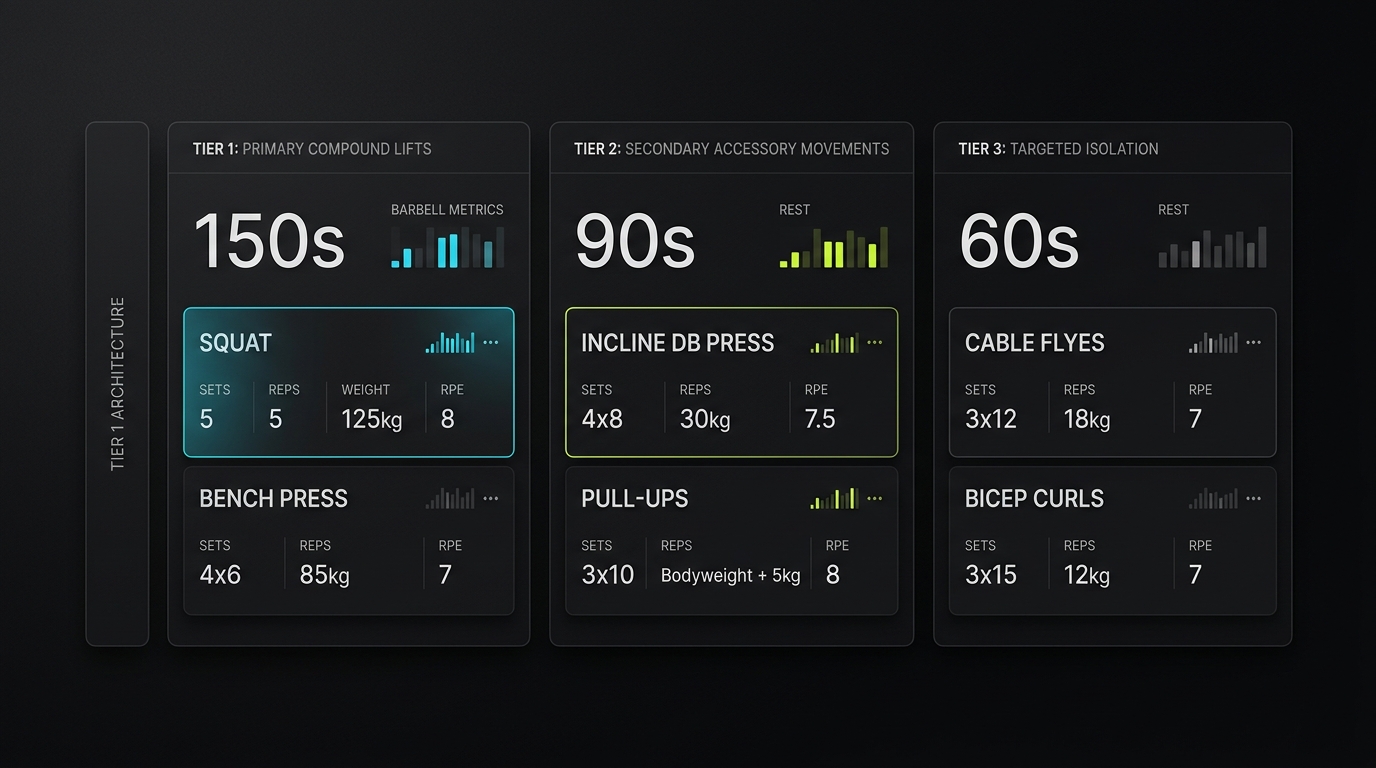
| Tier Category | Role in Workout Template | Prescribed Sets & Reps | Rest Target | Representative Exercises |
|---|---|---|---|---|
| Tier 1: Primary Compound | Highest systemic neural stimulus; foundation of strength and progressive overload. | 3–4 sets × 5–8 reps | 120–180 sec | Barbell Squat, Flat Bench Press, Deadlift, Overhead Press |
| Tier 2: Secondary Accessory | Reinforces compound movement mechanics while isolating target musculature with reduced spinal loading. | 3 sets × 8–12 reps | 90–120 sec | Incline Dumbbell Press, Romanian Deadlift, Lat Pulldown, Leg Press |
| Tier 3: Targeted Isolation | Maximizes localized metabolic stress and hypertrophy without imposing central nervous fatigue. | 2–3 sets × 12–15+ reps | 60–90 sec | Cable Lateral Raise, Incline Biceps Curl, Triceps Rope Pushdown, Leg Extension |
Rule of thumb: Place Tier 1 movements at the very start of your workout template when your central nervous system is fresh. Placing cable lateral raises before heavy overhead pressing exhausts stabilizer muscles and compromises pressing safety.
4. 3 Ready-to-Use Workout Templates (Full Body, Upper/Lower, PPL)
Below are three battle-tested workout template variations designed for different weekly training frequencies. Review their movement selections, set parameters, and rest interval standards:

3-Day Full Body Workout Template (Beginner to Intermediate)
Ideal for busy athletes who want maximum muscle protein synthesis frequency (training each muscle group 3 times weekly) with complete recovery days between sessions.
| Day / Session | Movement Order | Tier | Sets & Reps | Rest | Action Coaching Cue |
|---|---|---|---|---|---|
| Day 1: Full Body A | Barbell Back Squat | Tier 1 | 3 × 6–8 | 150s | Brace core; descend until hip crease clears knee. |
| Flat Dumbbell Press | Tier 1 | 3 × 8–10 | 120s | Retract scapulae; tuck elbows 45 degrees. | |
| Chest-Supported Row | Tier 2 | 3 × 10–12 | 90s | Drive elbows back; squeeze upper back at peak. | |
| Standing Calf Raise | Tier 3 | 3 × 15 | 60s | Hold 2s stretch at bottom of repetition. | |
| Day 2: Full Body B | Romanian Deadlift | Tier 1 | 3 × 6–8 | 150s | Hinge at hips; maintain flat spine with soft knees. |
| Standing Overhead Press | Tier 1 | 3 × 6–8 | 120s | Squeeze glutes; press vertically without arching back. | |
| Neutral Grip Lat Pulldown | Tier 2 | 3 × 10–12 | 90s | Pull bar to upper collarbone; avoid swinging torso. | |
| Dumbbell Lateral Raise | Tier 3 | 3 × 12–15 | 60s | Lead with elbows; pause momentarily at top. |
4-Day Upper / Lower Workout Template (Hypertrophy Standard)
The undisputed gold standard for intermediate lifters. Separates upper-body pushing/pulling from heavy lower-body compound movements, leaving your weekends free for complete rest.
Upper Body Focus (Day 1 & 3)
- 1. Barbell Bench Press — 3×6–8 (150s rest)
- 2. Barbell Bent-Over Row — 3×6–8 (120s rest)
- 3. Incline DB Bench Press — 3×8–10 (90s rest)
- 4. Cable Lat Pullover — 3×12 (60s rest)
- 5. Incline DB Biceps Curl — 2×12–15 (60s rest)
- 6. Cable Triceps Pushdown — 2×12–15 (60s rest)
Lower Body Focus (Day 2 & 4)
- 1. Barbell Back Squat — 3×6–8 (180s rest)
- 2. Romanian Deadlift (RDL) — 3×8–10 (150s rest)
- 3. Leg Press (Feet Mid-High) — 3×10–12 (90s rest)
- 4. Lying Hamstring Curl — 3×12–15 (60s rest)
- 5. Standing Calf Raise — 4×15 (60s rest)
- 6. Hanging Leg Raise — 3×15 (60s rest)
5-Day Push / Pull / Legs (PPL) Workout Template
Configured for advanced trainees who can accommodate 5 gym sessions per week. Provides specialized focus on synergistic muscle clusters (Chest/Shoulders/Triceps on Push, Back/Biceps on Pull, Quads/Hams/Calves on Legs).
5. 4 Golden Rules of Template Customization (Overload, Rest, Swaps)
When you adopt a public workout template, you will inevitably need to adjust it for gym crowdedness, personal biomechanics, and strength progression. Follow these four foundational rules to maintain program integrity:
Forget confusing 1RM percentage equations. If your workout template assigns 3×6–8 on Bench Press with 185 lbs, stay at 185 lbs until you can successfully complete 3 sets of 8 reps with solid form. Only then increase the load to 190 lbs and reset to 6 reps.
If the flat barbell bench is taken, swap it for a flat dumbbell bench or neutral-grip machine chest press. Never replace a horizontal compound press with a pec fly; your swap must preserve the same movement pattern and neuromuscular load.
Progressive overload cannot be verified if rest periods vary wildly. Hitting 8 reps after a 4-minute rest does not represent genuine muscular hypertrophy if your baseline was a 90-second rest. Use an automated countdown timer in yourworkout template.
Adding endless extra sets to your workout template yields diminishing returns. Research shows that 10 to 18 challenging weekly sets per muscle group maximizes hypertrophic stimulus. Anything more accelerates joint inflammation without promoting additional protein synthesis.
6. From Static Cell to Action-Driven Flow: The TrainFlow Upgrade
TrainFlow was engineered precisely to bridge the gap between structured desktop planning and distraction-free mobile gym execution. Instead of forcing you to navigate spreadsheets or lock yourself into rigid native apps, TrainFlow turns your workout template into a fluid, action-driven training flow:
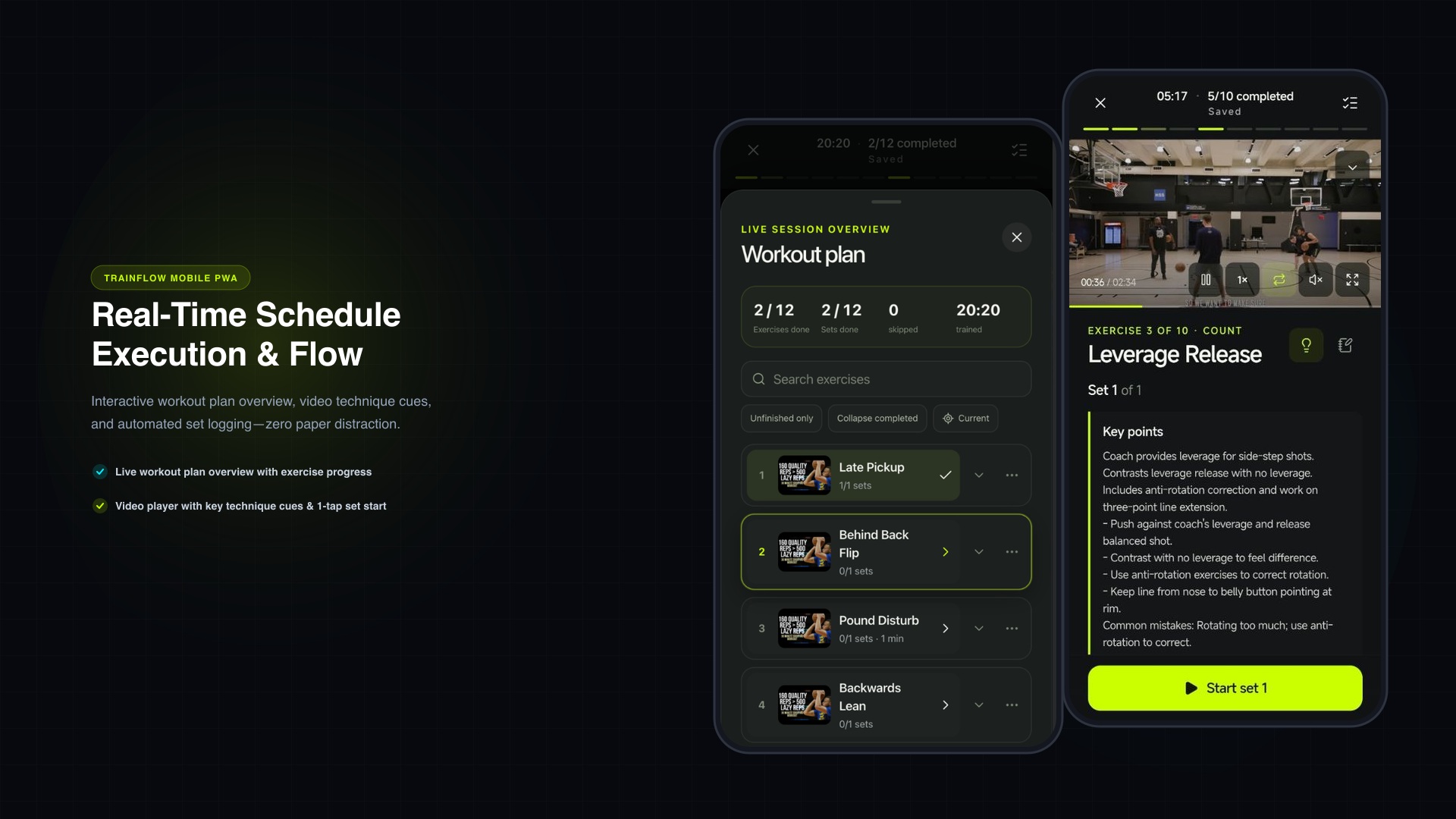
Attach exact video start and end timestamps to any exercise in your workout template. Verify your squat stance or hip hinge instantly without opening a separate YouTube app.
Check off sets with a single tap on your mobile browser. Weights and reps pre-populate from your previous session, eliminating 90% of gym typing.
Checking off a set automatically launches your configured rest timer. Audible chimes alert you when it is time to lift again, keeping you in an unbroken flow state.
7. Case Study: Eliminating 15-Minute Delays in a Busy Commercial Gym
Athlete Profile: Marcus T. (Intermediate Lifter, 28)
Goal: Hypertrophy & Upper-Body Strength | Schedule: 4 Days/Week
- Average session duration: 75–85 minutes.
- Spent 12+ minutes zooming and typing into spreadsheet cells.
- Inconsistent rest intervals (ranged from 45s to 4m 30s due to phone checks).
- Struggled to remember proper cable pulley height for chest flies.
- Average session duration tightened to 52 minutes (28% faster).
- One-tap completion saved ~10 minutes of screen interaction.
- Audible rest timer standardized every rest interval to exactly 90 seconds.
- Added 10 lbs to bench press working sets within 6 weeks using double progression.
Takeaway: An action-driven workout template saves time not by rushing exercises, but by removing dead phone time and streamlining transition friction between sets.
8. Frequently Asked Questions
What is a workout template and how does it differ from a routine?
A workout template is a reusable architectural framework defining exercise categories, movement orders, set counts, and target repetition ranges across your training week. In contrast, a routine is a specific, populated instance of that template with designated weights, exact exercise selections, and fixed rest intervals. A workout template gives you the blueprint, while a routine is the day-to-day session you perform.
Why do Google Sheets and Excel workout templates cause gym friction?
While a spreadsheet workout template works well on a desktop for long-term planning, it causes severe friction in the gym. Pinching and zooming into tiny spreadsheet cells, tapping numbers on tiny touch keyboards with sweaty hands, and losing your place between sets disrupts your training momentum. Furthermore, spreadsheet templates lack built-in rest countdown timers and do not show video form demonstrations when you need quick technique reminders.
How many exercises should be included in a balanced workout template?
An effective daily workout template should feature 4 to 6 total movements: 1 to 2 primary multi-joint compound lifts, 2 secondary compound or machine accessory exercises, and 1 to 2 targeted isolation movements. Programming more than 6 exercises per workout template generates junk volume, extending gym time past 60 minutes while reducing neural drive and progressive overload efficiency.
How long should I stick with one workout template before changing it?
You should commit to a single workout template for at least 8 to 12 consecutive weeks. Changing your workout template every week introduces muscle confusion myths and prevents neuromuscular motor learning, making it impossible to measure actual strength progression. You should only swap an individual exercise in your template if it causes persistent joint discomfort or after you plateau on double progression across three consecutive weeks.
Can I use these workout templates for body fat loss and cutting?
Yes. The biological objective of lifting weights under any workout template during a fat loss phase is muscle preservation under a caloric deficit. A structured strength workout template signals your body to retain metabolically active lean muscle mass while dietary nutritional deficits handle adipose fat reduction. Keep training volume moderate (10–14 weekly sets per muscle) and focus on maintaining heavy weights on primary lifts.
Is TrainFlow's interactive workout template free to use?
Yes. TrainFlow provides free interactive workout templates and routine builders accessible directly from any desktop or mobile browser. You can customize compound sets, reps, and automatic sound-cued rest timers without paying any subscription fees or needing credit cards.
Build Your Custom Workout Template Today
No credit card required. Assemble your exercises, configure rest countdowns, and run your workout template directly from your phone browser with seamless flow.